3 Minutes Reading Time
The Problem: Vibrant Memories, Empty Photo Albums
You can close your eyes and see it perfectly: The checkered floor of your grandmother’s kitchen. The specific shade of blue of your very first car. The nervous excitement in the air at the dance hall where you met your spouse in 1973.
These memories are vivid in your mind, but they are missing from your photo albums.
For years, this was the end of the road for personal documentaries. If you didn’t have the physical photo or the grainy 8mm film reel, that part of your story had to remain invisible. It could only be talked about, never shown.
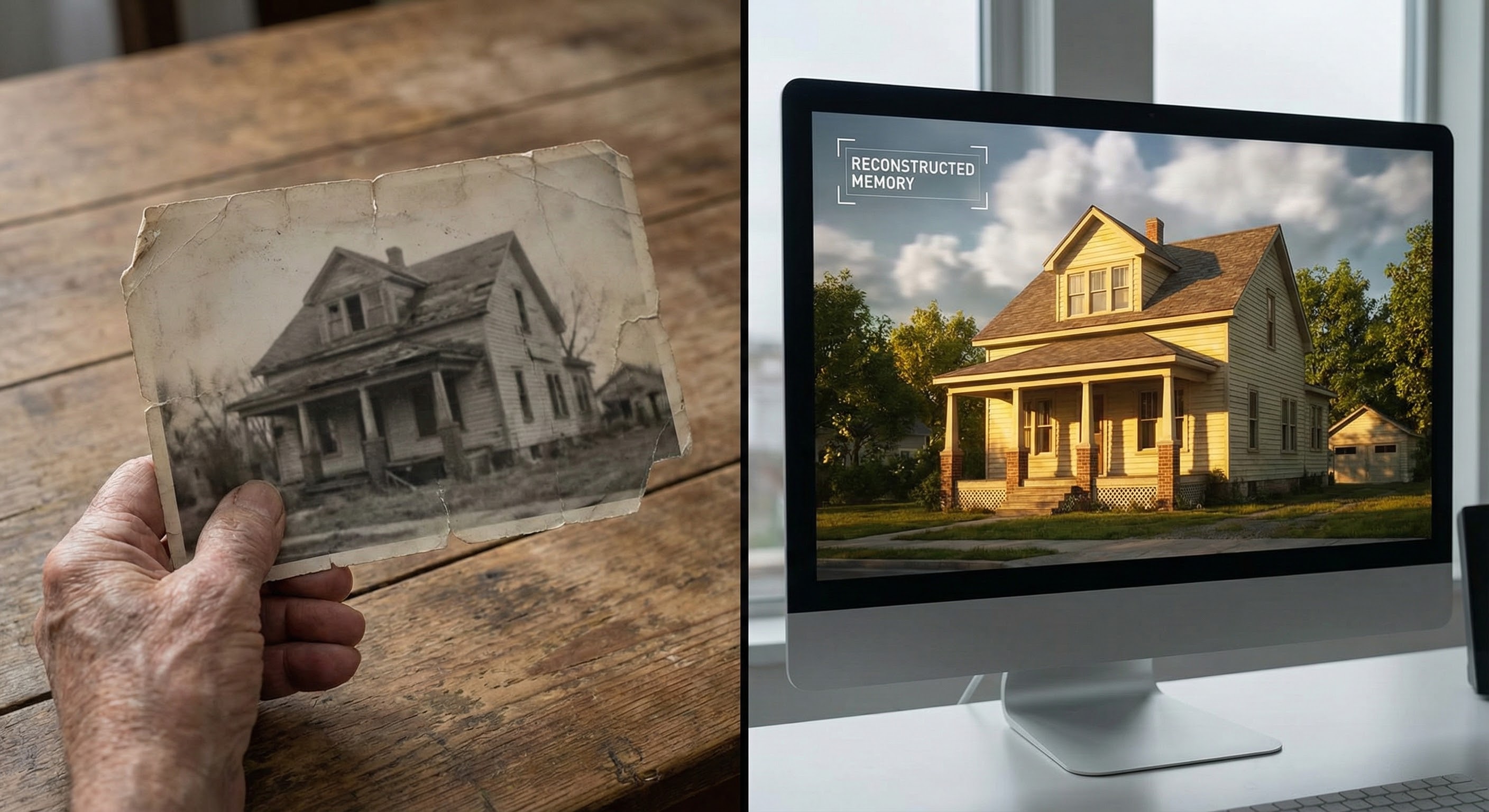
Today, that barrier is gone. At CinemaLab, we use sophisticated Artificial Intelligence (AI) tools to visualize the memories that no camera captured.
Addressing the Skepticism: Is it "Fake"?
When many older adults hear phrases like "AI video generation," they feel hesitant. It sounds cold, robotic, or perhaps inauthentic.
We understand that fear. So, let’s clarify what we do: We are not inventing a new life for you. We are creating an artistic reconstruction of the life you actually lived.
Think of it like a high-end Hollywood historical movie. When you watch a film set in ancient Rome or 1920s New York, you know the sets aren't "real"—they were built by designers based on historical research. Yet, they allow you to immerse yourself in the story emotionally.
We do the same thing on a personal scale. You provide the research (your memories), and we use AI as our set designer and cinematographer to build the scene.
Examples: What Can We Recreate?
If you can describe it, we can likely visualize it. Here are common examples of "missing footage" we help clients restore:
The Lost Spaces: The childhood home that was demolished decades ago. We reconstruct the facade, the porch, and the surrounding neighborhood based on your descriptions.
Historical Milestones: The specific atmosphere of the ship deck when you immigrated to America, or the crowded street scene on V-J Day.
Personal Moments: The moment of a proposal in a restaurant that no longer exists, or a quiet family dinner from a Tuesday night in 1965.
The Process: From Your Voice to the Screen
How does it actually work? It is a collaborative process between you, a human documentary director, and the technology.
Step 1: The Interview (The Human Foundation) Everything starts with your voice. In our filmed interviews, we don't just ask what happened; we ask how it looked. "Was it sunny? What were you wearing? What color were the walls?"
Step 2: The Script & Prompting Our directors take your detailed descriptions and translate them into highly specific "prompts" for the AI. This is where human artistry is crucial—guiding the technology to understand the mood and period-appropriate details.
Step 3: AI Visualization & Human Refinement The AI generates video clips based on these prompts. But the machine doesn't get the final say—you do. We review the footage, refine it, and ensure it matches the emotional truth of your memory.
The Final Pitch: Turning Scarcity into Abundance
Don't let a lack of old photos stop you from telling your story.
In the past, having only five blurry black-and-white photos was a limitation. Today, it’s an invitation. It means we get to creatively bring the rest of your rich history to life in stunning detail.
At CinemaLab, technology doesn't replace the human touch; it amplifies it, ensuring your legacy is as vibrant on screen as it is in your heart.