4 Minutes Reading Time
The Science of "Visual Memory"
We all know the feeling. You sit down with a dusty photo album, point to a faded black-and-white picture of a house, and say, "That is where I grew up."
Your grandchildren nod politely. They see a small, static square of a building. But you see so much more. You see the vibrant green of the grass that isn't captured in monochrome. You hear the specific creak of the front porch swing. You smell the Sunday dinner cooking through the open window.
There is a gap between what you remember and what you can share. For decades, that gap was impossible to bridge. But today, thanks to the intersection of documentary filmmaking and new technology, we can finally turn your memories into a shared experience.
Here is why visualizing your legacy is the most powerful gift you can leave behind.
Why do we remember movies better than textbooks?
Neuroscience tells us that the human brain processes visual information 60,000 times faster than text. But more importantly, our brains are wired for immersion. When we watch a video, "mirror neurons" in our brain fire, making us feel as though we are experiencing the event ourselves.
When you simply tell a story, the listener has to work hard to imagine it. When you show them the story—through cinematic reenactment or visualization—you bypass the effort and go straight to the emotion. You aren't just passing down information; you are transferring a feeling.
The "Missing Footage" of the Pre-Digital Era
If you were born before 1980, you likely face a common problem: The Visual Void.
You might have thousands of photos from the last ten years on your smartphone. But what about your childhood? What about your time in the service? What about the day you immigrated to a new country?
For most of the 20th century, video cameras were heavy, expensive, and rare. As a result, the most formative years of your life—the adventures, the struggles, the defining moments—exist only in your head. Until now, these stories were destined to remain abstract tales, slowly fading with each generation.
Preserving Atmosphere, Not Just Facts
A standard biography captures facts: Born in 1952. Married in 1975. Worked as a teacher.
But a legacy isn't built on facts; it’s built on atmosphere.
It’s not just that you took a ship to America; it’s the way the mist looked over the harbor that morning.
It’s not just that you met your spouse at a dance; it’s the lighting in the hall and the song that was playing.
These sensory details are the "glue" of memory. Without them, a story is just a report.
The CinemaLab Solution: Bridging the Gap with AI
At CinemaLab, we believe your memories deserve to be seen, not just heard. We have pioneered a new approach to personal documentaries that solves the problem of "missing footage."
We start with Human Connection: We sit with you for intimate, filmed interviews to capture your voice, your expressions, and your narrative.
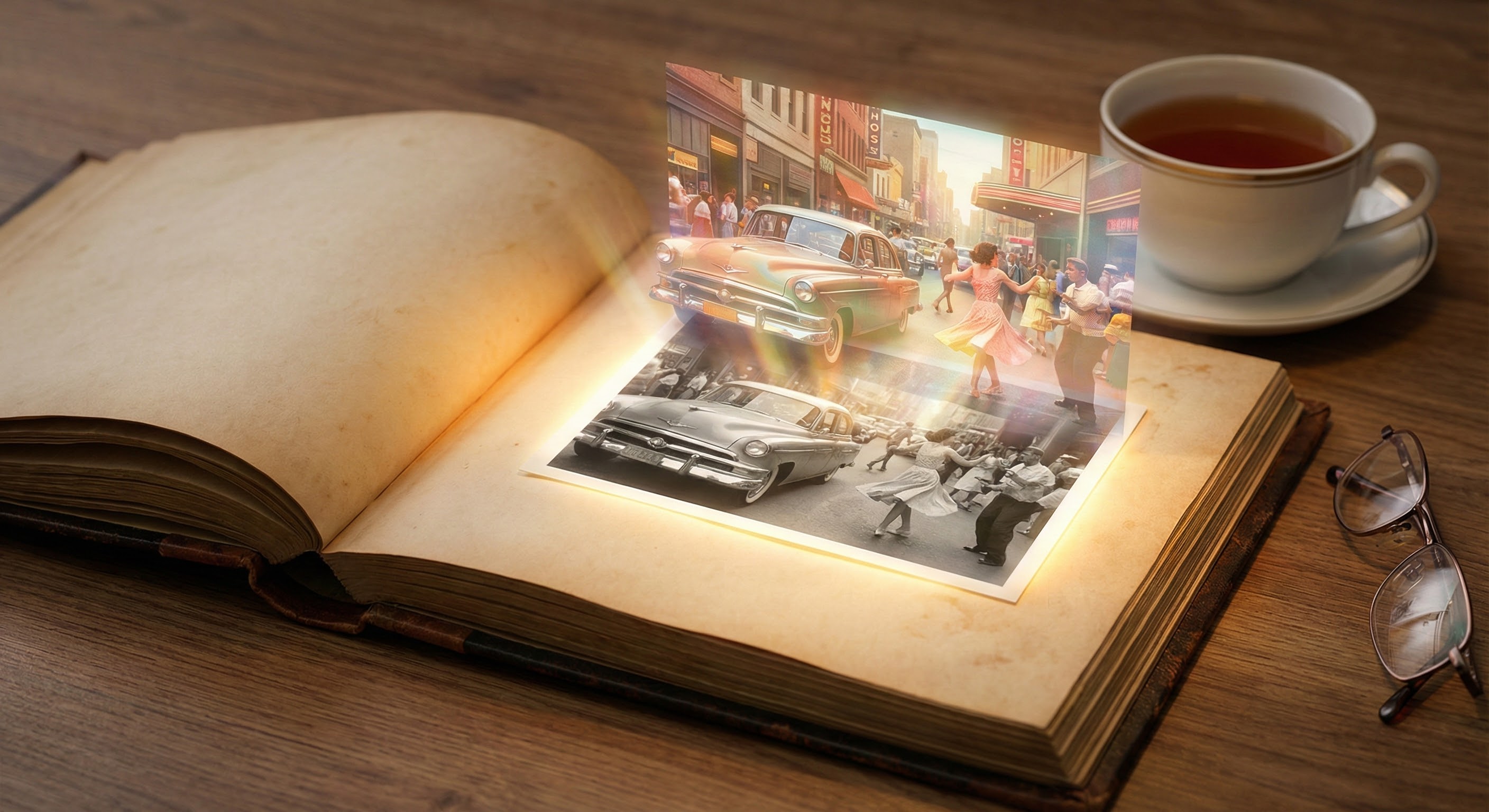
Then, we use Cinematic AI Visualization: Using cutting-edge technology, we take your detailed descriptions—the specific car you drove, the street you played on, the dress you wore—and we recreate those scenes on video.
We don't replace your truth; we enhance it. We fill in the visual gaps that the camera missed 40 or 50 years ago.
Give the Gift of Experience
Imagine your great-grandchildren sitting in a living room fifty years from now. They won't just hold a photo and guess what your life was like. They will watch a film. They will see the world through your eyes, hear your voice, and experience your journey as if they were there with you.
Don't let your best stories stay trapped in the past. Let’s bring them to the screen.